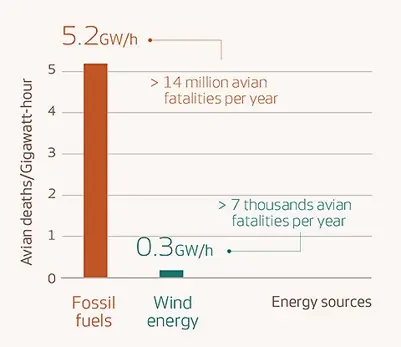
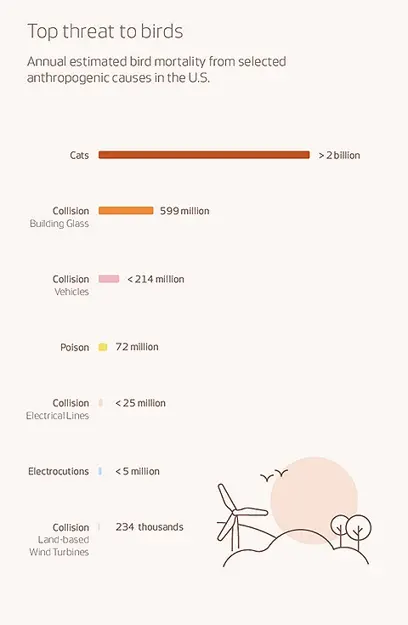
Are wind turbines a threat to birds and bats?

Responsible development

We work with local communities, environmental stakeholders, and authorities to address their specific concerns when developing a wind project. During the development stage of each project, we work with experts and biologists to study the effect on wildlife and create strategies to avoid or minimise impacts. We study our projects for at least a year to confirm low risk or adjust project siting if needed, and to ensure all projects comply with environmental regulations.

Vestas offers various practices to address the presence of birds and bats near wind turbines:

Deterrent systems protect species, primarily using sound to deter bats, which are more sensitive to sound. There are some technologies currently under development to reduce of the risk of bird fatalities and stop them from flying into turbines.


Curtailment involves temporarily stopping turbines based on factors like species presence or environmental conditions when they may be present, such as temperature, time of day/night, season, wind speed and direction. One study found that smart curtailment reduced bat mortality by 54%. [3]

Safeguarding bat species

Vestas developed intelligent software that adjusts turbine operations based on environmental factors related to bat activity. By predicting bat behavior and pausing turbines, when necessary, our Bat Protection System enhances performance while reducing environmental impact, lowering bat fatalities by up to 78%. [4]

1 Benjamin K. Sovacool, (2009). “Contextualizing Avian Mortality: A Preliminary Appraisal of Bird and Bat Fatalities from Wind, Fossil-Fuel, and Nuclear Electricity.” https://www.sciencedirect.com/science/article/abs/pii/S0301421509001074


Matthew Eisenson, Jacob Elkin, Andy Fitch, Matthew Ard, Kaya Sittinger, & Aamuel Lavine. (2024). Rebutting 33 False Claims About Solar, Wind, and Electric Vehicles (Vol. 1). Columbia Law School. https://scholarship.law.columbia.edu/sabin_climate_change


Bennett, E. M., Florent, S. N., Venosta, M., Gibson, M., Jackson, A., & Stark, E. (2022). Curtailment as a successful method for reducing bat mortality at a southern Australian wind farm. Austral Ecology47(6), 1329–1339. https://doi.org/10.1111/aec.13220


4 Martin, C., Arnett, E. B., Stevens, R. D., & Wallace, M. C. (2017). Reducing bat fatalities at wind facilities while improving the economic efficiency of operational mitigation. Journal of Mammalogy, 98(2), 387-385. https://academic.oup.com/jmammal/article-abstract/98/2/378/3064950?redirectedFrom=fulltext